
How Sciatica Is Diagnosed: The Exam That Finds the Cause
Diagnosing sciatica isn't about guessing from where it hurts — it's a careful history and physical exam that pinpoints which nerve root is irritated and where the compression sits. Here's what the straight-leg-raise test, reflex and strength checks, and sensation mapping actually reveal, when an MRI or nerve study genuinely matters, and what a chiropractic evaluation at Thrive Chiropractic in Troy, MI adds.
Why Diagnosis Matters More Than the Label
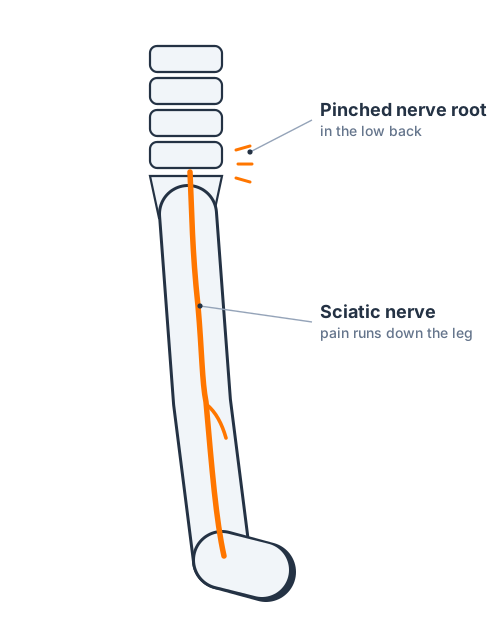
When pain shoots down your leg, it's tempting to think the whole story is in the name: you have sciatica. But sciatica isn't really a diagnosis — it's a description of a symptom, leg pain from an irritated sciatic nerve. The question that actually shapes your care is what's irritating the nerve, and where. Two people with nearly identical leg pain can have completely different sources, and the care that helps one may do little for the other.
That's why a good diagnosis isn't a scan or a single test — it's a careful process of matching your story to what a hands-on exam finds. Done well, it can tell which nerve root is being compressed and roughly where the problem sits in your spine, usually without any imaging at all. The reassuring part is that most sciatica is straightforward to evaluate this way, and the exam alone is often all it takes to build a plan that works.
It Starts With Your History
Before a hand is laid on you, most of the diagnosis comes from listening. The story of how your pain behaves is genuinely one of the most powerful diagnostic tools there is, and Dr. Rubinstein will ask a lot of specific questions to build it out:
- Where does the pain start, and how far down does it travel? True sciatica follows the nerve — down the buttock, the back of the thigh, and often past the knee into the calf or foot. Pain that stops at the buttock or thigh tells a slightly different story.
- How did it begin? A sudden onset after a lift or twist points toward a disc; a gradual build that flares with standing and walking leans toward stenosis; pain that started in the buttock and worsens with sitting hints at the piriformis.
- What eases it and what makes it worse? Whether bending forward, leaning back, sitting, or walking changes your symptoms is a real clue to the source.
- Are there other symptoms? Numbness, pins-and-needles, or weakness — and where exactly you feel them — help map which nerve is involved.
- Any red flags? Bladder or bowel changes, saddle numbness, or weakness in both legs are asked about early, because they change everything.
By the end of the history, there's usually a working theory of both the cause and the likely level. The exam then tests that theory.
The Physical Exam
The physical exam is where the theory gets confirmed or revised. It's hands-on, methodical, and — importantly — it's how the specific nerve and location get pinned down. A typical sciatica exam includes several layers:
- Watching you move. How you stand, walk, and shift can reveal a lot. Some people with a disc lean away from the painful side; some with stenosis prefer to stand slightly bent forward.
- Back and hip motion testing. Bending forward, leaning back, and twisting each load different structures. Which direction reproduces or relieves your leg symptoms helps separate a disc problem from a joint or a tight muscle.
- Palpation. Feeling along the lower back, pelvis, and buttock finds the segments that are stiff, tender, or in spasm — and can reproduce piriformis-type symptoms when the muscle in the buttock is the culprit.
- A neurological screen. This is the heart of it, and it deserves its own look below — checking your reflexes, muscle strength, and sensation to see which nerve root is affected.
- Nerve-tension tests. Gentle maneuvers, especially the straight-leg raise, that stretch the sciatic nerve to see whether that provokes your pain.
None of these is a verdict on its own. The diagnosis comes from the pattern they form together — and from how well that pattern matches your history.
The Straight-Leg-Raise Test
The straight-leg-raise test is the classic bedside check for sciatica, and it's simple. You lie on your back, relaxed, and the examiner slowly lifts your straight leg by the heel. The test is considered positive when that lifting reproduces the familiar shooting pain down the back of your leg — not just tightness in the hamstring — typically somewhere in the range of 30 to 70 degrees.
Why it works: raising the straight leg puts the sciatic nerve and its roots on a gentle stretch. If a disc or other structure is pressing on that nerve, stretching it provokes the pain, which points toward a nerve-root cause rather than a muscle or joint problem. Variations — lowering the leg slightly until the pain eases and then flexing the ankle, or testing the opposite leg — help refine how confident that finding is and hint at how the nerve is being compressed.
What the Exam Reveals About the Nerve
Here's the part that makes the neurological screen so valuable: each nerve root that feeds the sciatic nerve supplies a fairly predictable strip of skin, a particular muscle group, and a specific reflex. So the pattern of what's altered points to which root is being compressed — and, since each root exits at a known level of the spine, roughly where the problem sits.
In broad strokes, the exam looks at three things and reads them together:
- Sensation. Where you feel numbness or pins-and-needles maps to a nerve root. Altered feeling on the top of the foot and big toe suggests one level; numbness along the outer foot and sole suggests another.
- Strength. Testing specific movements — lifting the big toe or foot upward versus pushing the foot down, or rising onto the toes or heels — checks the muscles each root drives. A targeted weakness points to a targeted root.
- Reflexes. A diminished knee reflex versus a diminished ankle reflex again points to different levels.
When those three line up — say, numbness on the top of the foot, weakness lifting the big toe, and a preserved ankle reflex — they tell a consistent story about a particular nerve root. That's the difference between "you have sciatica" and "the irritation is most likely at this level, from this kind of cause," which is exactly the specificity that lets care be targeted. It's also why sciatica overlaps so closely with nerve-related neuropathy: the exam is reading how a nerve is behaving.
When Imaging or Nerve Studies Actually Matter
This is where a lot of worry gets created unnecessarily, so it's worth being clear. Imaging is not the first step for typical sciatica, and it isn't a routine part of the diagnosis. Most sciatica is evaluated on the history and exam, given a trial of conservative care, and improves — no scan required.
The reason isn't cost-cutting; it's accuracy. Disc bulges and age-related changes show up on the MRIs of a large share of people who have no leg pain at all. So an early scan frequently reveals "findings" that aren't actually the source of your symptoms, which can lead to worry, and sometimes to treatment aimed at the wrong target. The exam, matched to your story, is often the more reliable guide to what's really going on.
Imaging such as an MRI genuinely earns its place in specific situations:
- Symptoms that aren't improving over a reasonable stretch of conservative care
- Progressive weakness, or a foot that's dropping or dragging
- Red-flag signs suggesting serious nerve compression
- A history of significant trauma, cancer, infection, or other reasons to suspect something beyond a routine disc or muscle cause
- When surgery or an injection is being seriously considered, and the exact anatomy needs to be confirmed
Nerve conduction studies and EMG are even more selective. They test how well nerves and muscles are signaling, and they're most useful when the diagnosis is genuinely unclear — to confirm nerve involvement, gauge its severity, or tell sciatica apart from another nerve problem when the exam doesn't settle it. For the common, improving case, they add little. If one of these tests is warranted, Dr. Rubinstein arranges the right imaging or referral rather than continuing hands-on care alone.
What a Chiropractic Evaluation Adds
A chiropractic evaluation at Thrive Chiropractic in Troy, MI covers all the ground above — the detailed history, the orthopedic and neurological testing, the straight-leg raise — and adds a particular focus on how your lower back and pelvis move. Sciatica is so often a mechanical problem: a joint that isn't moving well, a disc under pressure, a muscle in the buttock clamping on the nerve. Reading that movement is central to identifying not just that a nerve is irritated, but what's doing the irritating and what might relieve it.
From there, the evaluation flows straight into a conservative plan matched to the findings — restoring motion to stiff lower-back and pelvic joints, spinal decompression when a disc is involved to gently reduce pressure on the nerve, and massage therapy to release a tight piriformis and the protective spasm around an irritated nerve. Just as important, a thorough evaluation knows its own limits: it recognizes the red flags and the persistent cases that need imaging or a medical referral, and coordinates that. You get an honest read on what's going on, an honest sense of the likely timeline, and a clear plan — starting from a diagnosis, not a guess. Once you know what's driving the pain, sciatica exercises matched to your case become far safer to begin.
When to Seek Prompt or Emergency Care
Most sciatica, even when the leg pain is severe, is not dangerous and settles with conservative care — and the diagnostic process is unhurried by design. But a small set of warning signs points to serious pressure on the nerves at the base of the spine, and those are a true emergency, not something to work up slowly.
Short of that, it's still worth being evaluated when leg pain, tingling, or numbness lingers past a couple of weeks, keeps recurring, comes with a weak leg or foot, or interferes with sleep, work, or daily life. Getting a clear diagnosis early gives conservative care the best chance to work. When you're ready, schedule a visit with Dr. Rubinstein at Thrive Chiropractic and get a thorough exam, an honest read on the cause, and a plan built around it. You can also read about sciatica symptoms and how sciatica compares to a herniated disc in the wider Sciatica library.
Frequently Asked Questions
Getting a sciatica diagnosis raises a lot of fair questions — whether you need an MRI, what the straight-leg-raise test actually shows, how the exam knows which nerve is affected, whether a chiropractor can diagnose it, and when nerve studies are needed. Those are answered in detail in the FAQ section on this page.
If pain is traveling down your leg and you want to know precisely what's driving it, schedule a visit with Dr. Rubinstein at Thrive Chiropractic in Troy, MI. You'll get a thorough exam, a clear diagnosis, and a conservative plan aimed at relieving the pressure on the nerve.
Sciatica Relief Guide (PDF)A one-page take-home guide: what helps sciatic nerve pain now, what's behind it, and the red flags that need urgent care.PDFThis article is for general education and is not a substitute for professional medical advice, diagnosis, or treatment. Always consult a qualified healthcare provider about your specific situation.
Frequently Asked Questions
Do I need an MRI to diagnose sciatica?
Usually not, at least not right away. Most sciatica is diagnosed and managed on the history and physical exam alone, with a trial of conservative care first. An MRI is reserved for specific reasons — symptoms that aren't improving, progressive weakness, or red-flag signs — partly because disc changes show up on the scans of plenty of people with no leg pain at all, so an early image can raise worry without changing the plan.
What is the straight-leg-raise test for sciatica?
It's a simple bedside test where you lie on your back and the examiner slowly raises your straight leg. If that movement reproduces the shooting pain down the back of your leg — usually somewhere between 30 and 70 degrees — it suggests the sciatic nerve or a nerve root is being stretched over something that's irritating it, which points toward a disc-related cause. It's one of several checks, not a standalone verdict.
How does the exam tell which nerve is affected?
Each nerve root supplies a fairly predictable strip of skin, a particular muscle group, and a specific reflex. So the pattern matters: numbness on the top of the foot, weakness lifting the big toe, and a normal knee reflex point to a different level than weakness pushing the foot down and a reduced ankle reflex. Mapping where you feel altered sensation, what's weak, and which reflexes have changed lets Dr. Rubinstein narrow down which root is involved.
Can a chiropractor diagnose sciatica?
Yes. A chiropractic evaluation includes exactly the history, orthopedic, and neurological testing used to identify sciatica and its likely source, plus a focus on how your lower back and pelvis move. Dr. Rubinstein pinpoints what's irritating the nerve, builds a conservative plan around it, and — importantly — recognizes the red flags and persistent cases that need imaging or a medical referral, arranging that rather than continuing hands-on care alone.
Are nerve conduction studies needed for sciatica?
Rarely for typical sciatica. Nerve conduction studies and EMG test how well nerves and muscles are signaling, and they're most useful when the picture is unclear — for instance, to confirm nerve involvement, judge its severity, or distinguish sciatica from another nerve problem when the exam alone doesn't settle it. For the common, improving case, they add little and aren't part of the routine workup.
Ready to get evaluated at Thrive Chiropractic?
Dr. Rubinstein will assess what’s really going on and build a care plan tailored to you. Reach out and we’ll get you scheduled.
2133 Crooks Road | Troy MI 48084