
Breech Baby & the Webster Technique: An Honest Guide
If your baby is breech, you have real questions and real options — most of them managed by your OB or midwife. Here's an honest look at what breech means, the medical options your provider oversees, and where the gentle, pregnancy-adapted Webster Technique fits in: supporting pelvic balance and easing tension, not turning the baby. Care at Thrive Chiropractic in Troy, MI, always alongside your birth team.
What Breech Presentation Means
"Breech" simply means your baby is positioned bottom-down or feet-down in the uterus, rather than head-down — the position most babies settle into for birth. If you've just been told your baby is breech, it's natural to feel a flutter of worry, so here's the reassuring context first.
Being breech is very common earlier in pregnancy. For much of your pregnancy your baby has plenty of room and moves around freely, spending time in all sorts of positions — head-up, head-down, and sideways. As your baby grows and space gets tighter later on, most babies settle into a head-down position on their own. So a breech baby at, say, a mid-pregnancy scan is entirely expected and usually nothing to read into. It's only as your due date gets closer, and your baby is still breech, that it becomes something your birth team will actively plan around.
If that's where you are, the most important thing to know is that the decisions ahead belong with your OB or midwife — and there are good options. This article explains those options in plain terms, and then honestly describes where gentle chiropractic care, and the Webster Technique specifically, does and does not fit.
The Options Your OB or Midwife Manages
If your baby is still breech as your due date nears, your provider will walk you through the options that fit your specific pregnancy. These are medical decisions, made with your birth team — not something to sort out on your own or through chiropractic. In broad terms, they often include:
- Watchful monitoring. Because many babies still turn head-down late, your provider may simply keep an eye on your baby's position with exams and, if needed, an ultrasound, giving your baby time to settle.
- External cephalic version (ECV). This is a procedure in which an obstetric provider uses their hands on your abdomen to gently attempt to turn the baby to head-down, usually near term and in a monitored setting. Whether it's suitable depends on your pregnancy, and it's entirely your provider's call to offer and perform.
- Birth planning for a breech baby. If your baby stays breech, your team will discuss the safest way to give birth in your situation, which frequently means a planned cesarean, though the right plan is individual.
Your OB or midwife weighs your health, your baby, and how far along you are to guide these choices. The role of chiropractic care sits outside all of this — it doesn't attempt any of the above. What it offers is something narrower and gentler, described next.
What the Webster Technique Actually Is
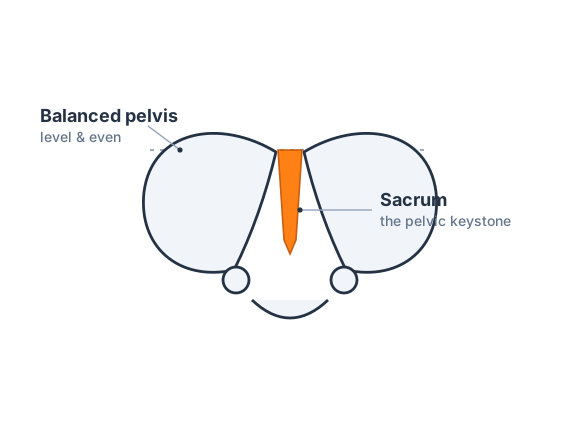
The Webster Technique is a gentle, pregnancy-focused chiropractic method that aims to balance the pelvis and reduce tension and constraint in the muscles and ligaments around it. It's the same approach used to help with the hip and pelvic discomfort of pregnancy, and you can read a fuller explanation in our Webster Technique explained guide.
Here's the honest reasoning behind it. As pregnancy progresses, the pelvis can be loaded unevenly and the muscles and ligaments that support the uterus can become tight or pulled to one side. The idea behind Webster is that a pelvis which moves evenly and isn't held in tension may give a baby more room and less restriction to find a comfortable position on its own. So the technique works on you — your pelvic alignment and the surrounding soft tissue — gently and with careful positioning, never on the baby directly.
That's the whole of it: support pelvic balance, ease tension and constraint, keep you comfortable. It's a reasonable, gentle thing to do during pregnancy. But it's just as important to be clear about what it is not.
What Webster Is Not
This is the part that gets oversold elsewhere, so we'll say it plainly:
- Webster is not a breech-turning maneuver. It is not ECV, and it does not attempt to turn your baby. No one is pushing or manipulating the baby into position.
- Webster does not "turn the baby." The chiropractor works on your pelvis and soft tissue, not the baby. Any change in your baby's position is something your baby does on its own, if it happens at all.
- Webster does not guarantee your baby will move head-down. There are no guarantees. Whether a baby settles head-down depends on many things well outside anyone's control.
- There are no honest "success rates" to promise. If anyone quotes you a specific percentage or promises an outcome, be skeptical — that's not a claim that can be made responsibly, and we won't make it.
Framed honestly, the Webster Technique supports your pelvic balance and comfort and reduces tension and constraint. That's a genuinely worthwhile thing during pregnancy. It is simply not a treatment that turns breech babies, and it always sits alongside — never instead of — the care and monitoring your OB or midwife provides.
When to Consider It
If you and your OB or midwife feel the Webster Technique is a reasonable part of your care, it's generally best considered earlier in the third trimester. The thinking is practical: earlier on, your baby still has more room and more time to settle into a head-down position, so supporting pelvic balance during that window makes more sense than waiting until the final weeks when space is tightest.
That's a general guide, not a hard rule, and the timing is a conversation to have with both your chiropractor and your birth team. Throughout, your OB or midwife keeps checking your baby's position and continues to steer the overall plan — including whether and when to consider ECV or to plan for a breech birth. Gentle chiropractic care runs in parallel with all of that; it doesn't change the medical plan, and it isn't a reason to delay or skip any step your provider recommends.
What to Expect at Thrive Chiropractic
At Thrive Chiropractic in Troy, MI, Dr. Rubinstein provides gentle, pregnancy-adapted care, always tailored to your stage and comfort. If you come in with a breech baby on your mind, the first thing you'll get is an honest conversation — what the Webster Technique can reasonably do, what it can't, and how it fits with the care your OB or midwife is providing. You won't be told it will turn your baby, because that's not what it does.
From there, care is gentle and positioned entirely for your comfort:
- Webster Technique to support pelvic balance and ease tension and constraint around the pelvis, adapted to how far along you are
- Soft-tissue and massage therapy to relax the tight muscles and ligaments around the low back, hips, and pelvis
- Comfort, posture, and movement guidance you can use between visits
Everything is designed to complement, never replace, your prenatal care. Dr. Rubinstein will encourage you to keep your OB or midwife informed and will happily coordinate with them, because they're the ones tracking your baby's position and guiding your birth plan. You can learn more on our pregnancy care page, and see how gentle care supports the weeks ahead in preparing for birth with chiropractic.
When to Seek Care
A breech baby earlier in pregnancy is expected and usually resolves on its own, and even a persistent breech position later on is something your birth team is well equipped to plan for. The most important step is simply staying in close contact with your OB or midwife about your baby's position as your due date approaches, and following their guidance on timing and options.
Some symptoms, though, need prompt attention regardless of your baby's position.
As always in pregnancy, your OB or midwife guides the decisions about a breech baby, and gentle chiropractic care works alongside them. When you're ready, you can schedule a visit and Dr. Rubinstein will give you a straight, honest picture of how the Webster Technique fits into your care. You can also read more across our Pregnancy Care library.
Pregnancy Comfort Guide (PDF)A one-page take-home guide: gentle ways to ease pregnancy aches, why they happen, and when to call your OB.PDFThis article is for general education and is not a substitute for professional medical advice, diagnosis, or treatment. Always consult a qualified healthcare provider about your specific situation.
Frequently Asked Questions
What does it mean if my baby is breech?
Breech means your baby is positioned bottom-down or feet-down in the uterus rather than head-down, which is the usual position for birth. It's very common earlier in pregnancy — babies move around freely and are often breech at that stage — and many settle into a head-down position on their own as they run out of room later on. If your baby is still breech as your due date nears, your OB or midwife will talk through the options with you.
Can the Webster Technique turn a breech baby?
No — and it's important to be honest about that. The Webster Technique does not turn babies and is not a breech-turning maneuver. It's a gentle chiropractic approach that aims to balance the pelvis and reduce tension and constraint in the surrounding muscles and ligaments. The thinking is that a balanced, relaxed pelvis gives a baby the best chance to get into a good position on its own, but there's no guarantee a baby will move, and any decision about position and birth stays with your OB or midwife.
Is the Webster Technique safe during pregnancy?
The Webster Technique is a gentle, pregnancy-focused chiropractic approach, with everything positioned and adapted for your comfort and your changing body — it's not a forceful adjustment. At Thrive, Dr. Rubinstein tailors it to how far along you are and how you're feeling. As with any care during pregnancy, it's meant to work alongside your OB or midwife, and keeping them informed is always part of the plan.
When should I start the Webster Technique if my baby is breech?
It's generally best considered earlier in the third trimester, while your baby still has more room to move and time to settle. That's not a hard cutoff, and it's a conversation to have with both your chiropractor and your OB or midwife — but the earlier window tends to be more sensible than waiting until the final weeks. Your provider continues to check your baby's position throughout.
What is external cephalic version (ECV)?
External cephalic version, or ECV, is a medical procedure in which an obstetric provider uses their hands on your abdomen to gently try to turn a breech baby to head-down, typically near the end of pregnancy and in a monitored setting. It's one of the options your OB or midwife may discuss with you. Whether it's appropriate depends on your specific pregnancy — it's entirely a medical decision made with your provider, separate from chiropractic care.
Does the Webster Technique guarantee my baby will turn?
No. There are no guarantees, and anyone promising a specific success rate or a certain outcome isn't being straight with you. The Webster Technique supports pelvic balance and comfort; whether a baby moves head-down depends on many factors outside anyone's control. Its honest role is to reduce tension and constraint and support your comfort, alongside the care and monitoring your OB or midwife provides.
Ready to get evaluated at Thrive Chiropractic?
Dr. Rubinstein will assess what’s really going on and build a care plan tailored to you. Reach out and we’ll get you scheduled.
2133 Crooks Road | Troy MI 48084