Scoliosis Screening in Children & Teens: A Parent's Guide
Scoliosis is a sideways curve of the spine that most often shows up during the growth years — usually without pain. Here's what it is, how school and pediatric screening and the forward-bend test work, what a curve means and the medical pathway of monitoring, bracing, and specialist referral, and — honestly — how gentle chiropractic care at Thrive Chiropractic in Troy, MI can support comfort, posture, and mobility alongside your child's medical team, while being clear that it does not straighten or cure a structural curve.
What Is Scoliosis?
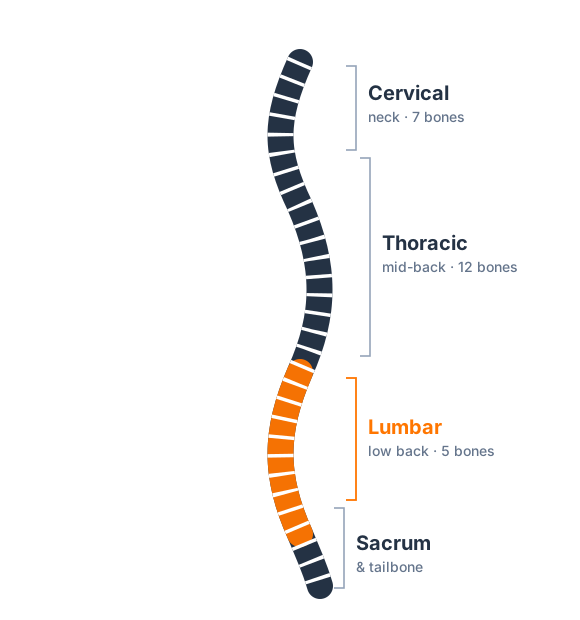
Scoliosis is a sideways curve of the spine — where the spine, viewed from behind, bends to the side into a "C" or "S" shape instead of running straight, usually with some rotation of the vertebrae as well. Everyone's spine has natural front-to-back curves; scoliosis is different because the curve goes side to side, and because it involves a twist that a simple slouch doesn't. You can read the full clinical picture on our main scoliosis page.
Most scoliosis in young people appears during the growth years of adolescence and has no single identifiable cause — this is called idiopathic scoliosis, and it's by far the most common type. The thing that surprises many parents is that it usually shows up not as pain but as a subtle asymmetry: one shoulder or hip sitting higher than the other, or a rib area that stands up when your child bends forward. Because it's often painless, a child rarely reports it — which is the whole reason screening exists.
Let's be honest and clear from the start, because it shapes everything below: a structural scoliosis curve involves the bones of the spine, and it can't be straightened, corrected, or reversed by hands-on care. What can be done — and done well — is to screen for it, get it appropriately monitored through the growth years, and support the comfort, posture, and mobility that sometimes go along with it. Setting that expectation honestly is far more useful than any promise to "fix" a curve. You can see how this fits into children's spinal health on our pediatric care page.
How Screening and the Forward-Bend Test Work
Because so much childhood scoliosis is painless, screening is how a possible curve gets noticed in the first place — often at school, at a pediatric well visit, or when a parent spots something looks uneven. Screening doesn't diagnose scoliosis; it flags a child who deserves a closer look.
The centerpiece is the forward-bend test (sometimes called the Adam's forward-bend test), and it's simple:
- Your child stands with feet together, then bends forward at the waist, arms hanging down and palms together, as if reaching for the toes.
- Whoever is screening looks along the back from behind, watching for a rib area or low-back area that stands up more on one side — the asymmetry a rotational curve produces.
- The screen also takes in overall posture and symmetry: shoulder height, whether the waist or hips look even, and whether the body is balanced over the pelvis.
What the screening is looking for, in plain terms, are these signs:
- Uneven shoulders, with one shoulder blade more prominent
- An uneven waist or hips, one side sitting higher
- The body leaning slightly to one side, or the head not quite centered
- A rib or low-back hump on one side on the forward bend — often the clearest sign
- Clothes that hang unevenly, a hemline or shoulder line that never sits right
One important limit: a forward-bend screen can suggest a curve, but it can't measure one. Only a standing X-ray confirms scoliosis and measures the size of the curve — and that measurement is exactly what drives every decision that follows.
What a Curve Means: The Medical Pathway
If screening and a pediatric evaluation point to a real curve, the natural next question is: now what? The honest answer is that it depends almost entirely on how large the curve is and how much growing your child has left — and that's why the medical pathway centers on measuring and monitoring rather than rushing to treat.
Here's how that pathway generally works, always guided by your pediatrician and, when needed, an orthopedic specialist:
- Monitoring for mild curves. Many curves are small and stable. For these, the plan is often simply to watch over time — periodic checks, and repeat standing X-rays when the specialist calls for them — because the biggest risk of a curve increasing is during a growth spurt.
- Bracing for certain moderate curves in a growing child. Bracing has a real, evidence-supported role for some moderate curves when a child is still growing. Its goal isn't to straighten the spine but to keep the curve from getting worse during growth, and it's most effective when started at the right time.
- Specialist referral and surgery for larger curves. Larger curves, or curves that keep progressing, are managed by an orthopedic spine specialist, who has the tools to measure precisely and weigh growth, size, and progression. Surgery is reserved for the larger end of that range.
The thread running through all of it is timing: catching a curve during the growth years is what makes appropriate monitoring and well-timed treatment possible. Getting your child in front of the right specialist at the right moment is one of the most valuable things screening makes possible — and it's a medical decision, made with imaging, not something conservative care substitutes for.
What Chiropractic Care Can and Can't Do
This deserves its own plain-spoken section, because it's the question every family asks — and the answer matters most here of anywhere.
What chiropractic care can't do: it can't straighten, correct, or reverse a structural scoliosis curve, and it can't cure scoliosis. The curve is a change in the shape of the spine itself, and no adjustment, exercise, or hands-on technique un-bends it. Anyone promising to "fix" or "reverse" a curve with adjustments is overselling — and with a child's spine, that honesty isn't optional.
What gentle chiropractic care genuinely can do is support the things that sometimes travel with scoliosis:
- Ease muscle tension and stiffness from the uneven muscle work around a curve
- Support comfort and mobility, keeping stiff areas moving and helping your child feel and move well
- Support posture and body awareness, which can help a child carry a curve more comfortably — even though it doesn't change the curve's size
- Help with related everyday aches — the ordinary stiffness and muscle soreness that respond to the same gentle care used for other complaints
Framed honestly, then, chiropractic care for a child with scoliosis is about supporting comfort, posture, and mobility — working alongside the medical monitoring, and, when needed, the bracing or specialist care that addresses the curve itself. That's a genuinely worthwhile role. It's simply not the same as fixing the curve, and we'll always tell you plainly where that line is.
What to Expect at Thrive Chiropractic
At Thrive Chiropractic in Troy, MI, care for a child with scoliosis — or with a posture asymmetry a screen has flagged — is conservative, gentle, and honest about its role. It's aimed at comfort, posture, and mobility, delivered alongside your pediatrician's monitoring, and if anything points to the need for medical evaluation, Dr. Rubinstein will say so plainly and help point you there. Care often includes:
- A careful history and posture screen, including a forward-bend check and symmetry assessment — and, importantly, a referral to your pediatrician for medical evaluation and imaging if a significant curve is suspected
- Gentle, low-force techniques to ease stiffness and restore comfortable motion in the areas around a curve, scaled to what a child's spine tolerates — never forceful
- Soft-tissue and light massage therapy to release the tight, overworked muscles on one side of a curve and ease the imbalance-driven aching
- Gentle posture and mobility work to build balanced support and body awareness, helping your child carry a curve more comfortably
- Custom orthotics where foot mechanics or a leg-length difference are adding to a postural imbalance
Throughout, the aim is honest and specific: a more comfortable, better-moving back and support in carrying a curve — not a promise to straighten it. For a growing child, care stays coordinated with the medical monitoring that tracks the curve itself, and if a curve reaches the size where bracing or a specialist's decision is warranted, you'll be told plainly and pointed in the right direction. Our guides to chiropractic for teens and everyday posture and backpack habits cover related ground.
When to Have Your Child Evaluated
Because childhood scoliosis is so often painless, the signs to act on are usually visual. It's worth having your child evaluated when you notice:
- Uneven shoulders, waist, or hips, or one shoulder blade that stands out
- The body leaning to one side, or clothes that consistently hang unevenly
- A rib or low-back hump on one side when your child bends forward
- A posture asymmetry a school or pediatric screening has flagged
- Back aching or stiffness in a child that lingers or travels with a visible asymmetry
The right first step for a suspected curve is your pediatrician, who can examine your child and decide whether a standing X-ray and an orthopedic referral are warranted. Gentle chiropractic care can play a supportive, comfort-and-posture role alongside that — and if you'd like a posture screen and honest guidance, you can schedule a visit with Dr. Rubinstein. Because a curve's greatest potential to change is during growth, getting it looked at early is what makes appropriate monitoring possible.
When to Seek Prompt or Emergency Care
Scoliosis itself is usually a condition to monitor and manage over time, not an emergency. But a small set of warning signs in a child calls for prompt medical attention — and some are true emergencies that go to your pediatrician or 911 rather than a wait-and-see approach.
Short of those warning signs, a child's curve is something to screen for, monitor through the growth years, and support gently for comfort and posture — always alongside the medical team who measures and manages the curve. If your child has a curve you'd like a supportive, honest set of eyes on, you can schedule a visit, and you can also explore the wider Pediatric Care library and our main scoliosis guide for related reading.
Kids & Chiropractic: A Parent's Guide (PDF)A one-page parent's guide: how gentle pediatric care works alongside your pediatrician, and the signs to get your child checked.PDFThis article is for general education and is not a substitute for professional medical advice, diagnosis, or treatment. Always consult a qualified healthcare provider about your specific situation.
Frequently Asked Questions
Can a chiropractor straighten or cure my child's scoliosis?
No — and we'd rather be straight with you than overpromise. A structural scoliosis curve involves the bones of the spine and can't be straightened, corrected, or reversed by adjustments, exercises, or any hands-on care. What gentle chiropractic care can genuinely do is support the comfort, posture, and mobility side of things — easing muscle tension and stiffness and helping a child move well — while your pediatrician and, when needed, an orthopedic specialist monitor and manage the curve itself. Be cautious of anyone who promises to 'cure' or 'reverse' scoliosis; a structural curve doesn't work that way.
What is the forward-bend test?
The forward-bend test (sometimes called the Adam's forward-bend test) is a simple screening step. Your child stands with feet together and bends forward at the waist, arms hanging and palms together, as if reaching for their toes. Whoever is screening — a school nurse, pediatrician, or chiropractor — looks along the back from behind for a rib area or a low-back area that stands up more on one side, which is the kind of asymmetry a rotational curve produces. It's a screen, not a diagnosis: it can flag a possible curve, but confirming and measuring one takes a standing X-ray.
Does my child need a brace or surgery?
It depends heavily on the size of the curve and how much growing is left, which is why monitoring is so central. Many mild curves are simply watched over time. Bracing has a real, evidence-supported role for certain moderate curves in a child who is still growing, with the goal of keeping the curve from getting worse during growth. Surgery is reserved for larger curves. These decisions belong with an orthopedic specialist, and your pediatrician will coordinate that referral when a curve warrants it.
Is scoliosis painful in children?
Often it isn't. In children and teens, mild scoliosis is frequently painless and is picked up on posture — uneven shoulders or hips — rather than pain, which is exactly why screening exists. Discomfort becomes more likely with larger curves and with the muscle imbalance around a curve. When scoliosis does cause aching or stiffness in a child, that comfort side is where gentle chiropractic care can help, alongside the medical monitoring of the curve.
Will my child's curve get worse?
Not necessarily. Many curves, especially milder ones, stay stable. The greatest potential for a curve to increase is during a growth spurt, which is why kids and teens are monitored closely through the growth years. Periodic evaluation — and standing X-rays when the specialist calls for them — is how your child's specific curve is tracked so that monitoring, bracing, or referral stays matched to it.
My child's school screening flagged a possible curve. What now?
First, don't panic — a screening flag means 'worth a closer look,' not a diagnosis, and many flagged children turn out to have a mild curve or a postural asymmetry rather than a significant structural curve. The next step is an evaluation by your pediatrician, who can examine your child and decide whether a standing X-ray and an orthopedic referral are warranted. Gentle chiropractic care can play a supportive, comfort-and-posture role alongside that process, but the curve itself is monitored and managed through the medical pathway.
Ready to get evaluated at Thrive Chiropractic?
Dr. Rubinstein will assess what’s really going on and build a care plan tailored to you. Reach out and we’ll get you scheduled.
2133 Crooks Road | Troy MI 48084