Scoliosis: Causes, Symptoms & How Chiropractic Helps
Scoliosis is a sideways curve of the spine that most often appears during the growth years of adolescence. Here's what's happening in the spine, how it's monitored, when bracing or an orthopedic referral matters, and — honestly — how conservative chiropractic care at Thrive Chiropractic in Troy, MI helps with the associated pain, posture, and mobility, while being clear about what it can and can't change.
What Is Scoliosis?
Scoliosis is a sideways curve of the spine — where the spine, viewed from behind, bends to the side into a "C" or "S" shape instead of running straight, usually with some rotation of the vertebrae as well. Everyone's spine has natural front-to-back curves; scoliosis is different because the curve goes side to side, and because it involves a twist that a simple slouch doesn't.
Most scoliosis appears during the growth years of adolescence and has no single identifiable cause — this is called idiopathic scoliosis, and it's by far the most common type. It often shows up not as pain but as a subtle asymmetry a parent, coach, or school screening notices: one shoulder or hip sitting higher than the other, or a rib area that stands up when the child bends forward. Less commonly, scoliosis is present from birth or is linked to another condition affecting the nerves or muscles. In adults, a curve may be one carried since adolescence, or a new degenerative curve that develops as the spine's joints and discs wear with age.
The most important thing to be honest about from the start is this: a structural scoliosis curve involves the bones of the spine, and it can't be straightened by hands-on care. That reality shapes everything below. What can be done — and done well — is to monitor the curve appropriately, and to help with the pain, muscle imbalance, posture, and mobility that often accompany it. Setting that expectation honestly is more useful than any promise to "correct" a curve.
What's Happening in Your Spine
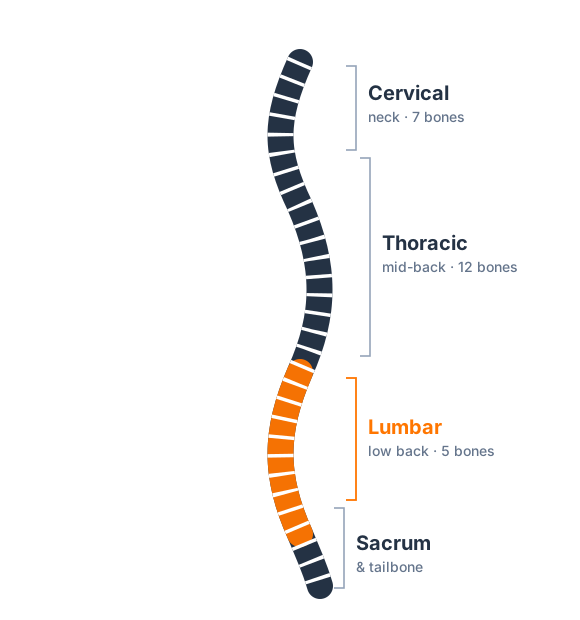
To picture scoliosis, start with a normal spine. Viewed from behind, it runs in a straight vertical line; viewed from the side, it has gentle front-to-back curves that balance your posture. In scoliosis, that straight-from-behind line is replaced by a sideways curve, and the individual vertebrae within the curve are usually rotated, turning slightly as the spine bends. That rotation is why a scoliosis curve often produces a subtle change in the shape of the back — a rib area or a low-back area that stands up a little more on one side.
A few things follow from that geometry:
- The muscles work unevenly. With the spine curved, the muscles on one side are lengthened and the other shortened, and the two sides work differently to hold you upright. This muscle imbalance is a common source of the aching, tightness, and muscle spasm that can accompany scoliosis.
- Posture shifts. A curve can leave one shoulder or hip looking higher, or the body slightly off-center — which is often the first thing anyone notices.
- In larger or aging curves, joints and nerves feel it. A pronounced curve, or an adult degenerative curve, loads the spinal joints unevenly and can, at times, crowd a nerve — territory shared with spinal arthritis and sciatica.
Crucially, the bones of a structural curve hold their shape — the curve isn't something you can un-bend by sitting up straight, the way you can correct a slouch. That's the line between a postural asymmetry and a structural scoliosis, and it's part of what an evaluation sorts out.
Common Signs and Symptoms
Because so much scoliosis is picked up before it hurts, the early signs are visual more than painful. You or a parent might notice:
- Uneven shoulders, with one blade more prominent than the other
- An uneven waist or hips, with one side sitting higher
- The body leaning slightly to one side, or the head not quite centered over the pelvis
- A rib or low-back area that stands up on one side when bending forward to touch the toes — often the clearest sign
- Clothes hanging unevenly, a hemline or shoulder line that never sits right
When scoliosis does cause symptoms, they tend to include:
- Aching or tightness in the back, often related to the uneven muscle work around the curve
- Muscle fatigue after standing or sitting for long stretches
- Shoulder or upper-back discomfort with higher curves, and low-back aching with lower ones — overlapping with upper back pain and lower back pain
- In adults especially, back pain and sometimes leg symptoms if a curve is crowding a nerve
In children and teens, mild curves are frequently painless — which is exactly why screening and monitoring matter. In adults, pain is a more common reason the curve gets attention in the first place.
Who's Most at Risk?
Scoliosis is most associated with:
- Adolescents during growth spurts, especially around the pre-teen and early teen years — the classic window for idiopathic scoliosis to appear and, if it's going to, to increase
- Girls, who are more likely than boys to have a curve that progresses enough to need treatment
- Children with a family history of scoliosis, since it tends to run in families
- Children with certain nerve or muscle conditions, in whom scoliosis can develop as a secondary effect
- Older adults, in whom a degenerative curve can develop as the spine wears — overlapping with the changes described in spinal arthritis
Because the greatest potential for a curve to change is during adolescent growth, that's the group watched most closely — a mild curve caught early can be monitored through the growth years, when catching progression matters most. Our pediatric care approach keeps that monitoring gentle and age-appropriate.
How Scoliosis Is Evaluated and Monitored
Evaluation and, just as importantly, monitoring are where care for scoliosis really lives — because knowing whether a curve is small and stable or larger and changing is what determines everything else. At Thrive Chiropractic, Dr. Rubinstein starts with a careful history — the child's age and growth stage, any family history, whether there's pain, and what's been noticed about posture.
The physical exam typically includes:
- A forward-bend screen, watching for the rib or low-back prominence on one side that a rotational curve produces
- Posture and symmetry checks — shoulder height, waist and hip level, and how the body is balanced over the pelvis
- Range-of-motion and muscle assessment, mapping the tightness and imbalance around the curve
- A neurological screen when there's any limb involvement — reflexes, strength, and sensation — to check for nerve irritation
Imaging has a defined role in scoliosis. Because the size of the curve drives the plan, a standing X-ray is the standard way to confirm a curve and measure it, and periodic imaging is how a growing child's curve is tracked over time to see whether it's stable or increasing. That measurement is precisely the information that guides whether a curve is simply monitored, braced, or referred — which is why this is one condition where imaging genuinely earns its place. When a curve reaches the size where those decisions come into play, Dr. Rubinstein coordinates care with an orthopedic specialist rather than managing it alone.
What Chiropractic Care Can and Can't Do
This deserves its own plain-spoken section, because it's the question every family asks.
What chiropractic care can't do: it can't straighten a structural curve, and it can't cure or reverse scoliosis. The curve is a change in the shape of the spine itself, and no adjustment, exercise, or hands-on technique un-bends it. Anyone promising otherwise is overselling.
What chiropractic care genuinely can do is help with the things that so often travel with scoliosis:
- Ease the pain and muscle tension that come from the uneven muscle work around a curve
- Improve mobility and comfort, keeping stiff areas moving and the surrounding soft tissue balanced
- Support posture and body awareness, which can help you carry a curve more comfortably even though it doesn't change the curve's size
- Address related back pain — the everyday aching, stiffness, and flare-ups that respond to the same conservative care used for other back conditions
Framed honestly, then, chiropractic care for scoliosis is about managing symptoms and keeping you moving well, working alongside the medical monitoring — and, when needed, the bracing or specialist care — that addresses the curve itself. That's a genuinely valuable role; it's just not the same as fixing the curve.
What to Expect at Thrive Chiropractic
At Thrive Chiropractic in Troy, MI, care for scoliosis is conservative, gentle, and built around your (or your child's) exam findings — aimed at comfort, mobility, and posture, and delivered alongside appropriate monitoring and referral. Care often includes:
- Gentle chiropractic adjustments or mobilization to ease stiffness and restore comfortable motion to the areas around the curve, using techniques scaled to what the spine tolerates — with low-force methods where they're the better fit, especially for children
- Soft-tissue and massage therapy to release the tight, overworked muscles on one side of a curve and ease the imbalance-driven aching
- Corrective posture and mobility exercises to build balanced support, improve body awareness, and help you carry the curve more comfortably — the corrective exercise side of the work
- Custom orthotics where foot mechanics or a leg-length difference are adding to the imbalance
- Gentle spinal decompression in selected adult cases where a degenerative curve is crowding a nerve
Throughout, the aim is honest and specific: a more comfortable, better-moving back and support in carrying the curve — not a promise to straighten it. For a growing child, care stays coordinated with the orthopedic monitoring that tracks the curve itself. If a curve reaches the size where bracing or a specialist's decision is warranted, you'll be told plainly and pointed in the right direction.
When Bracing or an Orthopedic Referral Matters
Conservative comfort care and medical management of the curve aren't in competition — they work together, and knowing when the second is needed is part of doing right by you. Referral to an orthopedic spine specialist matters when:
- The curve is moderate to large, past the point where symptom care alone is the whole answer
- The curve is increasing on repeat imaging, especially during a child's growth spurt
- The child is still growing and the curve is in the range where bracing can help — because bracing has a real, evidence-supported role in keeping certain curves from worsening during growth, and it's most effective when started at the right time
- There are nerve symptoms — leg pain, numbness, or weakness — accompanying an adult curve
Bracing decisions and surgical decisions belong with the orthopedic specialist, who has the tools to measure the curve precisely and weigh growth, size, and progression. Dr. Rubinstein's role in those situations is to recognize when that input is needed, coordinate the referral, and continue supporting comfort and mobility alongside the specialist's plan. Getting a growing child in front of the right specialist at the right time is one of the most valuable things monitoring makes possible.
Caring for Your Spine at Home
A few habits support comfort and mobility alongside professional care — with the same honest caveat that they help you feel and move better, not straighten the curve.
A few more habits worth building in:
- Stay consistent with prescribed exercises. Regular posture and stabilization work is what keeps the surrounding muscles balanced and comfortable over time.
- Set up workspaces and study spaces well. Supported seating and a screen at eye level ease the strain of long hours — the same ergonomic principles that help with upper back pain.
- Keep up general activity. Broad, balanced movement — walking, swimming, general fitness — supports a comfortable back and overall health.
- Keep monitoring appointments. For a growing child, staying on schedule with evaluations is how progression is caught early enough to act on.
If pain is worsening, or leg symptoms appear, treat that as a signal to be re-evaluated rather than waited out.
When to Seek Prompt or Emergency Care
Scoliosis itself is usually a condition to monitor and manage over time, not an emergency. But as with any spine condition, a small set of warning signs points to serious nerve compression and should never be waited out.
Short of that emergency, it's worth being evaluated when you notice a new or changing curve, when back pain related to a curve lingers or worsens, when a child's posture asymmetry seems to be increasing, or when leg symptoms accompany an adult curve. For a growing child especially, getting a curve looked at early is what allows appropriate monitoring and timely referral.
Frequently Asked Questions
Scoliosis raises a lot of understandable questions — whether a chiropractor can fix or straighten it, whether it's painful, whether a child needs a brace or surgery, whether it will get worse, and whether adults can develop it. Those are answered in detail in the FAQ section on this page, always with an honest line between what care can relieve and what it can't change.
If you or your child has a curve you'd like evaluated, or back pain you suspect is related to scoliosis, schedule a visit with Dr. Rubinstein at Thrive Chiropractic in Troy, MI. You'll get a careful exam, an honest explanation of what the curve does and doesn't call for, appropriate monitoring, coordination with a specialist where it's warranted, and conservative care aimed at keeping you comfortable and moving well. You can also explore the wider Back Pain library for related topics like upper back pain and lower back pain.
Back Pain Relief Guide (PDF)A one-page take-home guide: simple steps that help now, what's usually behind back pain, and the warning signs that mean it's time to see a doctor.PDFThis article is for general education and is not a substitute for professional medical advice, diagnosis, or treatment. Always consult a qualified healthcare provider about your specific situation.
Frequently Asked Questions
Can a chiropractor fix or straighten scoliosis?
No — and we'd rather be straight with you than overpromise. A structural scoliosis curve involves the bones and can't be straightened by adjustments, exercises, or any hands-on care. What chiropractic care can genuinely do is help with what often comes along with scoliosis: back pain, muscle tension and imbalance, stiffness, and posture. So the honest framing is managing and relieving symptoms and keeping you moving well, not curing or reversing the curve itself.
Is scoliosis painful?
In children and teens, mild scoliosis is often not painful at all and is picked up on posture rather than pain. Discomfort becomes more common with larger curves, with the muscle imbalance around a curve, and in adults, where a long-standing or degenerative curve can ache. When scoliosis does cause pain, that pain is exactly what conservative chiropractic care is well suited to help with.
Does my child's scoliosis need a brace or surgery?
It depends heavily on the size of the curve and how much growing is left, which is why monitoring is so important. Many mild curves are simply watched over time. Bracing has a real role for certain moderate curves in a child who is still growing, with the goal of keeping the curve from getting worse during growth. Surgery is reserved for larger curves. These decisions belong with an orthopedic specialist, and Dr. Rubinstein will help coordinate that referral when the curve warrants it.
Will scoliosis get worse over time?
Not necessarily. Many curves, especially milder ones, stay stable. The greatest potential for a curve to increase is during a growth spurt in adolescence, which is why teens are monitored closely. In adults, a curve can slowly change as the spine ages. Periodic evaluation is how your specific curve is tracked so care and referrals stay matched to it.
Can adults develop scoliosis?
Yes. Some adults have carried a curve since adolescence, and others develop a new curve later in life as the spine's joints and discs wear — a form called degenerative scoliosis. Adult scoliosis is more likely to come with back pain and, at times, nerve-related leg symptoms, both of which conservative care can help manage while any larger curve is co-managed with a specialist.
Ready to get evaluated at Thrive Chiropractic?
Dr. Rubinstein will assess what’s really going on and build a care plan tailored to you. Reach out and we’ll get you scheduled.
2133 Crooks Road | Troy MI 48084