
Core Stability for Back Pain: A Safe, Progressive Routine
A strong, well-coordinated core is one of the best forms of long-term protection your lower back has. But 'core work' doesn't mean crunches — it means training the deep muscles that quietly stabilize your spine. Here's why the deep core matters, a safe and progressive routine you can build at home, the pain signals that mean stop, and how core training fits alongside care at Thrive Chiropractic in Troy, MI.
Why Your Core Protects Your Back
Ask most people what their "core" is and they'll point at their abs and think of crunches. But the core that actually protects your back is deeper and quieter than that. It's a group of muscles that wrap around your midsection and lower spine and work together to hold it steady — bracing the spine so that when you bend, twist, lift, or simply sit for hours, the load is shared and controlled rather than dumped onto the joints and discs of your lower back.
Think of it as a natural corset. When that corset is strong and switches on at the right moments, your lumbar spine stays supported through the movements of daily life, and it's far less likely to be overloaded or strained. When it's weak or slow to engage — which happens easily after months of sitting, or after a sore back has made you move less — the spine loses that support and tires, guards, and complains more readily. That's why rebuilding the deep core is one of the most effective long-term steps for back pain, and why it sits at the center of nearly every good care plan.
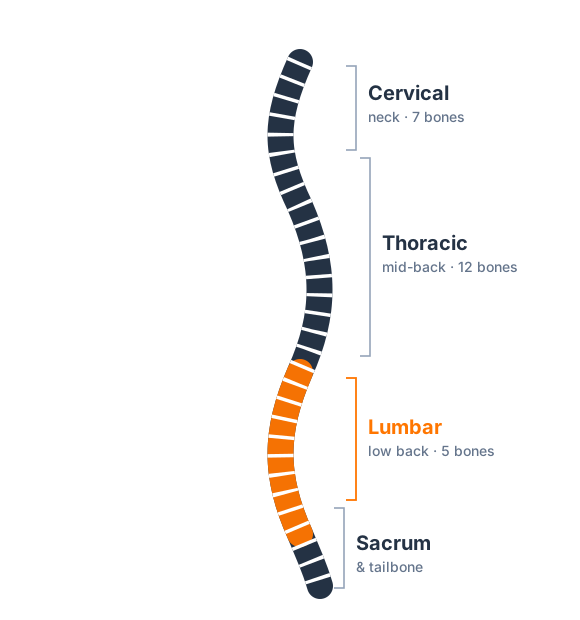
Meet the Deep Core
"The core" is really a team, and three players do most of the stabilizing work for your lower back:
- The transverse abdominis. The deepest abdominal muscle, it wraps around your waist like a wide belt. When it tightens, it creates a firm, supportive tension around your midsection that braces the spine from the front and sides — the central action behind a good "brace."
- The multifidus. Small but important muscles that run along the back of the spine, connecting the vertebrae segment to segment. They fine-tune and stabilize each level of the lower back, and they're often the first to weaken and switch off after back pain — which is exactly why retraining them matters.
- The glutes. The powerful muscles of the buttocks and hips. They're not "core" in the abdominal sense, but they anchor and control the pelvis, and strong glutes take a huge amount of load off the lower back during standing, walking, and lifting. A weak, underused set of glutes leaves the low back doing work it was never meant to.
The goal of core stability work isn't to make these muscles bigger or to grind out reps. It's to make them strong, coordinated, and quick to engage so they support your spine automatically, without you having to think about it.
Before You Start: Safety First
Core stability training is gentle, controlled, and pain-aware. A few ground rules keep it helping rather than hurting:
- Brace gently — don't clench. Aim for a firm, low-level tension around your whole midsection, as if bracing for a light poke to the stomach. Not a hard suck-in, not a held breath.
- Keep breathing. This is the one people miss. Breathe steadily and smoothly throughout every exercise. If you're holding your breath to do a move, it's too hard — ease off.
- Move slowly and stay in control. Stability work is about control, not speed or effort. Slow, precise reps switch on the deep core; fast, sloppy ones don't.
- Keep your spine neutral. Most of these moves are done with your lower back in a comfortable, natural position — neither flattened hard nor arched. Let the core hold it steady rather than forcing it.
- Never self-manipulate. Do not twist, wrench, or try to "crack" your own back to force relief. It bypasses the very control that makes movement safe and can irritate a joint or nerve. Leave any adjusting to a hands-on exam.
- Stop if it causes leg symptoms. Pain, numbness, or tingling running into a leg is a signal to stop that movement and get it checked, not to push through.
Some symptoms mean core work should wait entirely until you've been evaluated.
The Progressive Core Routine
Build this up in order. Start with the foundational moves until they feel easy and controlled, then layer in the harder ones. Do the routine every other day so the muscles can recover, and stop any single exercise that provokes leg symptoms.
- Pelvic tilt (the foundation). Lying on your back with knees bent and feet flat, gently tighten your lower abdominal muscles to rock your pelvis and flatten your lower back lightly toward the floor, then release. Small and controlled. This is the simplest way to feel the deep core switch on — master it first, because the gentle brace it teaches underlies everything else.
- Glute bridge. Lying on your back with knees bent and feet flat, squeeze your glutes and lift your hips until your body forms a straight line from shoulders to knees. Hold briefly, then lower with control. Start with eight to ten. This wakes up and strengthens the glutes that take load off your lower back.
- Bird-dog. On your hands and knees, brace gently, then slowly extend one arm forward and the opposite leg back until they're in line with your body — keeping your back flat and level and your hips square, not sagging or twisting. Hold a moment, return with control, and switch sides. This trains the multifidus and the whole core to stabilize your spine during real, cross-body movement.
- Dead bug. Lying on your back with your arms reaching toward the ceiling and knees bent at 90 degrees, keep your lower back gently supported and steady as you slowly lower one arm overhead and the opposite leg toward the floor, then return and switch sides. The key is that your back and pelvis stay still while your limbs move — if your back starts to arch up, reduce how far you reach.
- Modified plank, then side plank. Begin with a plank from your knees and forearms, holding a straight line from head to knees with your core braced and your hips level — build up your hold gradually. When that's comfortable, progress to a side plank from the knees, stacked on one forearm with your hips lifted and steady, to train the side core that resists twisting. Only advance to a full plank on your toes once the knee versions feel easy and controlled.
Keep the numbers modest and the form clean. Eight controlled reps or a short, steady hold beat twenty rushed ones — sloppy stability work is how a session turns into a new strain. For a broader mix of mobility and strength that pairs well with this, see our guide to back pain exercises.
Braced Neutral vs. a Collapsed Core
Whether these exercises protect your back or irritate it comes down to one thing: whether your core is actually bracing and holding your spine steady, or whether the spine is left to sag and collapse while your limbs move. The dead bug shows the contrast perfectly.
The same principle carries across every move in the routine: set a gentle brace, keep your spine in its neutral supported position, breathe, and move only as far as you can while staying in control. If you can't hold that, shorten the range or the reps rather than pushing through. Control is what makes core work both safe and effective.
Building It Into a Plan
You don't need a long or punishing program. A short, consistent routine you actually keep up beats an ambitious one you abandon after a week.
Listen to your back day to day. On a stiff or sore day, lean on the gentlest moves and shorter holds; on a good day, do a little more. And if you're recovering from a specific problem, the exercises you're given at Thrive Chiropractic take priority over this general routine — they're matched to your exam. Strong core habits are also a cornerstone of preventing future back pain, so what you build here keeps paying off long after a flare settles.
How Core Work Fits Your Care
Core stability training is powerful, but it works best as part of a plan rather than in isolation — and it isn't a substitute for getting a persistent problem evaluated. Sometimes a back is too irritated, too guarded, or too restricted for core work to land on its own; a stiff, locked segment or an irritated disc can keep the deep core switched off no matter how diligently you train.
That's where hands-on care fits alongside your routine. At Thrive Chiropractic in Troy, MI, Dr. Rubinstein can pinpoint what's actually driving your pain and pair targeted care — chiropractic adjustments to restore motion to stiff segments, massage therapy to release guarding muscles, and spinal decompression when a disc is involved — with a core and movement plan built specifically for you. Very often, hands-on care creates the comfortable, well-moving window in which core training finally starts working, and the core work then keeps that window open and protects the gains.
If your pain travels down your leg, comes with numbness or tingling, or simply isn't improving after a few weeks of consistent effort, that's the moment to schedule a visit rather than keep grinding through a routine that isn't landing. You may also want to read about when to see a chiropractor for back pain.
Frequently Asked Questions
Core stability work raises fair questions — whether it really helps, which exercises are best, whether sit-ups belong in the mix, how to brace correctly, and how long it takes to feel a difference. Those are answered in detail in the FAQ section on this page.
If your back is bothering you and you'd like a core routine built for your situation rather than a generic list, schedule a visit with Dr. Rubinstein at Thrive Chiropractic in Troy, MI. You'll get a thorough exam, an honest read on what's driving the pain, and a movement plan matched to it. You can also explore the wider Back Pain library, including back pain exercises and preventing future back pain.
Back Pain Relief Guide (PDF)A one-page take-home guide: simple steps that help now, what's usually behind back pain, and the warning signs that mean it's time to see a doctor.PDFThis article is for general education and is not a substitute for professional medical advice, diagnosis, or treatment. Always consult a qualified healthcare provider about your specific situation.
Frequently Asked Questions
Does core strength really help back pain?
For many people, yes. The deep core muscles stabilize the lower spine so it isn't overloaded through everyday bending, lifting, and sitting, and rebuilding them is a well-established part of long-term back care. The catch is that it has to be the right kind of core work — gentle stability training rather than hard crunches — and matched to what's actually driving your pain, which is what an exam sorts out.
What are the best core exercises for lower back pain?
The dead bug, bird-dog, glute bridge, side plank or a modified plank, and the pelvic tilt are among the safest and most effective, because they train the core to stabilize the spine without loading it into repeated forward-bending. The 'best' set for you depends on your situation, though — so if you have a diagnosis or leg symptoms, Dr. Rubinstein can tailor the routine rather than leaving you to guess.
Are sit-ups and crunches good for back pain?
Usually not, especially during a flare. Traditional sit-ups and crunches repeatedly bend the lower spine forward under load, which can irritate a sore back or an unhappy disc rather than help it. Stability-style exercises that keep your spine in a neutral, supported position while the core works give you the strength without that repeated strain.
How do I brace my core correctly?
Think of gently tightening your midsection as if you were about to be lightly poked in the stomach — a firm, low-level tension all the way around, not a hard suck-in or a held breath. You should still be able to breathe and talk. That gentle, all-around brace is what steadies your spine during an exercise or a lift; over-bracing and holding your breath does more harm than good.
How long until core exercises help my back?
Give it consistency over weeks rather than days. Deep-core strength and coordination rebuild gradually, so the meaningful gains — more support, fewer flares — tend to show up over several weeks of steady, sensible practice. Trying to rush it with hard sessions usually backfires. If you've been at it consistently for a few weeks with no change, that's worth an evaluation.
Ready to get evaluated at Thrive Chiropractic?
Dr. Rubinstein will assess what’s really going on and build a care plan tailored to you. Reach out and we’ll get you scheduled.
2133 Crooks Road | Troy MI 48084