
Back Pain While Sitting: Why It Happens & What It Means
Back pain that shows up when you sit — and eases when you stand or walk — is one of the clearest patterns in the lower back, and it often points toward the discs. Here's why sitting loads your spine so heavily, what the pattern usually means, how chiropractic care at Thrive Chiropractic in Troy, MI helps, and how to sit without paying for it.
What Is Back Pain While Sitting?
Back pain while sitting is discomfort in the lower back that comes on — or gets noticeably worse — when you're seated, and often eases once you stand up and move. It's one of the most position-specific back patterns there is: some people are fine on their feet all day but can't get comfortable in a chair, a meeting, or a long drive. That "worse sitting, better standing" rhythm is a genuinely useful clue, because it tends to point toward a particular set of structures in the spine.
The reason comes down to load. It's a common assumption that sitting rests your back, but for the lumbar spine the opposite is often true — sitting, especially slouched, puts more pressure on your discs than standing does. When that's the setup, the discs and joints spend your seated hours under sustained strain, and the back lets you know. The purpose of this guide is to explain why sitting is so hard on the lower back, what the pattern usually means, and — because sitting pain overlaps closely with disc issues — where to read more on the specific cause rather than repeating it here.
Why Sitting Loads Your Lower Back
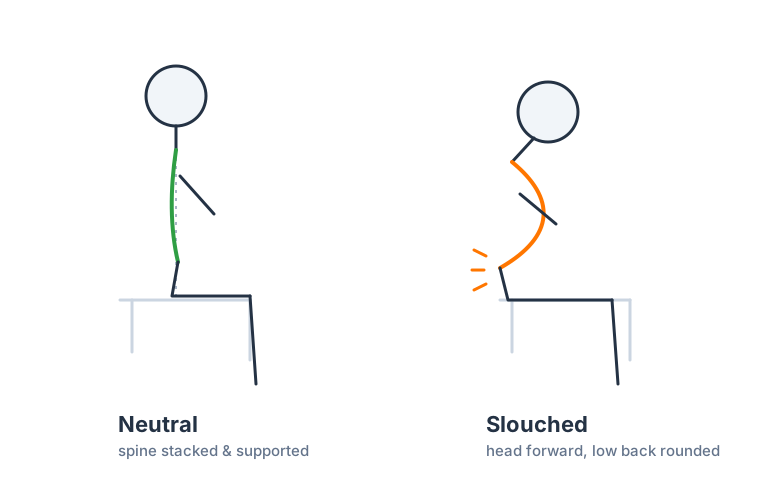
To see why sitting can hurt, picture what happens to the lumbar spine when you sit down. Standing tall, your lower back holds a gentle inward curve and load is shared across the discs, joints, and muscles. The moment you sit — and especially the moment you slouch — a few things change:
- The lumbar curve flattens or reverses. Sitting tends to tuck the pelvis and round the lower back, undoing its natural inward curve. That shifts load off the joints and muscles and onto the front of the discs.
- Disc pressure climbs. With the curve rounded, the pressure inside the lumbar discs rises above what it is when you stand. A slouched, unsupported sit is one of the higher-load positions your lower back experiences in ordinary life.
- The supporting muscles switch off. Slumping into a chair lets the deep muscles that stabilize your spine go quiet, so the passive structures — discs and ligaments — carry more of the burden.
Hold that for hours, day after day, and it's easy to see how the discs and surrounding tissue become irritated. Crucially, how you sit changes the load a lot: a supported, upright sit keeps the curve and shares the load, while a collapsed slouch concentrates it on the discs. That's why posture and sitting duration both matter — and why the fix is rarely "never sit" but rather "sit better and move more."
What Sitting Pain Usually Points To
Because sitting is a disc-loading position, back pain that is worst when you sit often — though not always — points toward the discs as the source. Rather than re-explain each disc condition here, these pages cover the underlying causes in depth:
- Lumbar herniated disc — when the soft center of a disc pushes through its outer ring and irritates nearby tissue or a nerve, sitting frequently makes it worse and can send pain down the leg. The herniated disc page explains what's happening and how it's managed.
- Bulging disc — a broader, less severe outward bulge of a disc that also tends to be aggravated by the sustained pressure of sitting. The bulging disc page walks through how it differs from a herniation.
- Back pain from desk work — the everyday combination of long seated hours and a poor workstation setup, which is the most common real-world driver of sitting-related back pain.
Not every case of sitting pain is a disc — muscle fatigue from a poor chair, tight hips, and simple deconditioning all play in too. The point of naming the disc conditions is so you know where to read further if the pattern fits; an exam is what actually confirms which structure is involved, so there's no need to self-diagnose from the sitting clue alone.
How to Sit Without Hurting Your Back
Since how you sit drives so much of the load, a few setup changes make a real difference. The core idea is to keep your lower back's natural inward curve supported instead of letting it round.
Alongside good posture:
- Support your lower back. Sit fully back into a chair that supports your lumbar curve, or add a small cushion or rolled towel behind your lower back.
- Set your desk up right. Screen at eye level so you're not craning forward, hips level with or slightly above your knees, feet flat on the floor or a rest.
- Don't hold any one position for hours. This is the big one — no posture, however good, is meant to be static all day.
What to Expect at Thrive Chiropractic
At Thrive Chiropractic in Troy, MI, care for sitting-related back pain is conservative and built around your exam. Dr. Rubinstein will ask exactly when the pain shows up, whether standing or walking relieves it, whether anything travels into a leg, and what your workstation and daily sitting look like — because that pattern helps point to whether a disc is involved.
Care often combines chiropractic adjustments to restore motion to stiff lumbar and pelvic joints, soft-tissue and massage therapy to release the muscle tension long sitting builds up, and — when a disc is the source — spinal decompression to gently reduce pressure on the disc and any crowded nerve. You'll also get practical coaching on your sitting setup, since fixing the workstation is often what keeps the pain from returning. Custom orthotics may factor in when foot mechanics are adding uneven load. This is management rather than a one-time cure — most improvement comes over a series of visits — and if your exam turns up something that needs medical attention, Dr. Rubinstein will say so and coordinate the right referral.
Easing Sitting-Related Back Pain at Home
A few habits genuinely help alongside professional care:
- Break up long sitting with brief, frequent standing or walking breaks — the single most effective change for most people.
- Support your lumbar curve in the chairs and car seats you use most, with a cushion or lumbar roll if needed.
- Vary your positions through the day — sit, stand, and move rather than locking into one setup, at a standing desk included.
- Keep gently active. Staying mobile within comfort beats long rest, which tends to stiffen the back further.
- Strengthen your core gradually, since stronger trunk muscles take load off the discs when you sit. Never try to twist or crank your own back to relieve it.
If your pain is getting worse despite these steps, or it starts traveling down your leg with numbness or tingling, treat that as a signal to be evaluated rather than waited out.
When to See a Chiropractor
Occasional stiffness after a marathon day at the desk is normal. It's worth getting evaluated when back pain from sitting keeps coming back, doesn't ease within a couple of weeks, or starts interfering with work, sleep, or the things you enjoy. Getting ahead of it gives conservative care the best chance to work before a short-term ache settles in.
A small set of symptoms, though, are emergencies and should never be waited out.
Short of those emergencies, pain that radiates down the leg — often sciatica when a disc is crowding a nerve — along with numbness or tingling, is a good reason to be seen sooner. When you're ready, you can schedule a visit with Dr. Rubinstein for a thorough exam and a conservative plan. You can also explore the wider Back Pain library for related patterns like back pain while standing and morning back stiffness.
Back Pain Relief Guide (PDF)A one-page take-home guide: simple steps that help now, what's usually behind back pain, and the warning signs that mean it's time to see a doctor.PDFThis article is for general education and is not a substitute for professional medical advice, diagnosis, or treatment. Always consult a qualified healthcare provider about your specific situation.
Frequently Asked Questions
Why does my back hurt more when I sit than when I stand?
Sitting actually loads your lumbar discs more than standing does, especially when you slouch — the pressure inside the discs climbs when the lower back rounds and the curve flattens. So a back that feels better on your feet but aches in a chair is following a recognizable pattern that often points toward the discs. Standing and walking offload the discs, which is why the pain frequently eases when you get up.
Can sitting too long cause a herniated disc?
Prolonged, slouched sitting is one of the loads that contributes to disc trouble over time, though it's rarely the single cause on its own. Sitting keeps the discs under sustained pressure and lets the supporting muscles weaken, which sets the stage — and then an ordinary lift or twist can be what tips a vulnerable disc over. The lumbar herniated disc page covers how this develops and what helps.
What is the best sitting posture for back pain?
The best posture keeps your lower back's natural inward curve supported rather than rounded. That usually means sitting back into a chair that supports your lumbar spine, hips level with or slightly above your knees, feet flat, and your screen at eye level so you're not craning forward. Just as important, no single posture is meant to be held for hours — changing position and standing up regularly matters as much as the posture itself.
Can a chiropractor help with back pain from sitting?
Yes. Chiropractic care restores motion to stiff spinal joints, relieves the muscle tension that long sitting builds up, and — when a disc is involved — aims to reduce the pressure on it. Dr. Rubinstein also looks at your workstation and daily sitting habits, since those are usually part of the problem. After an exam, you'll get a plan matched to what's actually driving your pain.
How often should I stand up if I sit all day?
A good rule of thumb is to change position and stand, stretch, or walk every 30 minutes or so. The exact number matters less than the principle: your spine isn't built to hold one loaded position for hours, and regular movement offloads the discs, keeps the joints mobile, and wakes up the muscles that support your back. Even brief, frequent breaks add up.
Ready to get evaluated at Thrive Chiropractic?
Dr. Rubinstein will assess what’s really going on and build a care plan tailored to you. Reach out and we’ll get you scheduled.
2133 Crooks Road | Troy MI 48084